Scale of tile making
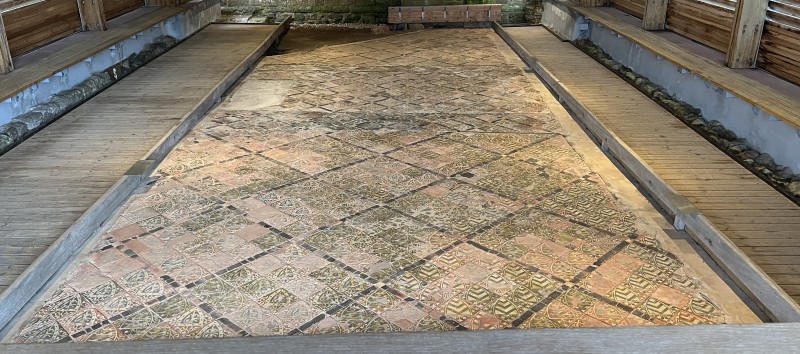
Assuming a fired tile is 6 inches square (they are often smaller) there are 36 tiles to a square yard and an area 10 yards by 10 yards would have required 3600 tiles. Public areas in cathedrals and palaces were generally large - tiles would have been required in their thousands. For example the Chapter House at Salisbury was originally tiled with inlaid floor tiles and it is a octagon shape with a diameter of 58 ft. The floor area isabout 260 square yards and would have required about 9,500 six inch tiles or 13,500 five inch tiles.
Winchester College has historic financial records dating back to the 1200’s and these supply some details and costs. In 1395 3,500 William Tyler of Otterbourne was paid 10 shillings (twenty shillings to the pound) per thousand tiles for an order of 8000 tiles for the chancel and vestry. This is one old penny (d - 12 to the shilling) per 8 tiles. Other records from 1397 refer to a cost of 11 shillings for laying 5500 tiles - so 1 penny for laying 42 tiles. At the time labour costs were 1½d to 2d a day for a labourer and 3d to 4d for a skilled mason. It seems that the production of simple floor tiles was a process of mass production rather than refined art work. Tilers would have needed to make many, many tiles a day so the production processes would have been streamlined to minimise cleaning and drying, etc between tiles and to eliminate un-necessary steps.
Initially tiles were made in smaller numbers (think King and Queens Chamber at Clarendon Palace) by workers paid by the day and working for the King or a senior bishop. This would have fostered a higher level of workmanship and a greater tolerance of failures and reject tiles. As tiles became more popular and were used for bigger areas (think Chapter Houses and retrochoirs) financial pressures would have pushed down prices and, probably, the quality of workmanship.
Looking at how several modern potters make tiles I think many of the processes adopted are from the earlier, higher quality period and some of these do not scale up to allow production of tiles in their thousands. I plan to look at issues that would arise as production was scaled up. How do we minimise the steps in the process, how do we keep each step simple and quick, how do we limit the amount of equipment needed, how do we ‘protect’ the most valuable pieces of equipment (the stamps), can we split tasks into highly skilled (master tiler) and simple steps (apprentices).
I have been looking at online videos of potters in the Indian sub-continent making bricks, tiles and ‘single use’ pottery vessels. These start to show how many production issues listed above are addressed. I have started looking at the frames used to define/contain the tile as it is made. Can the side walls be sloped slightly so that the tile edge chamfer is pre-defined and does not have to be created. Can the mould depth be the same as the tile thickness so that the mould can be ‘over filled’ by throwing the clay into the mould with some force and then surplus clay just wired off. I am pretty certain the medieval potters did not bother to weigh clay! If the moulds are to be ‘slam-loaded’ this needs softer clay. How does this affect the pattern stamping - do not want to have to wait for the clay to dry out.